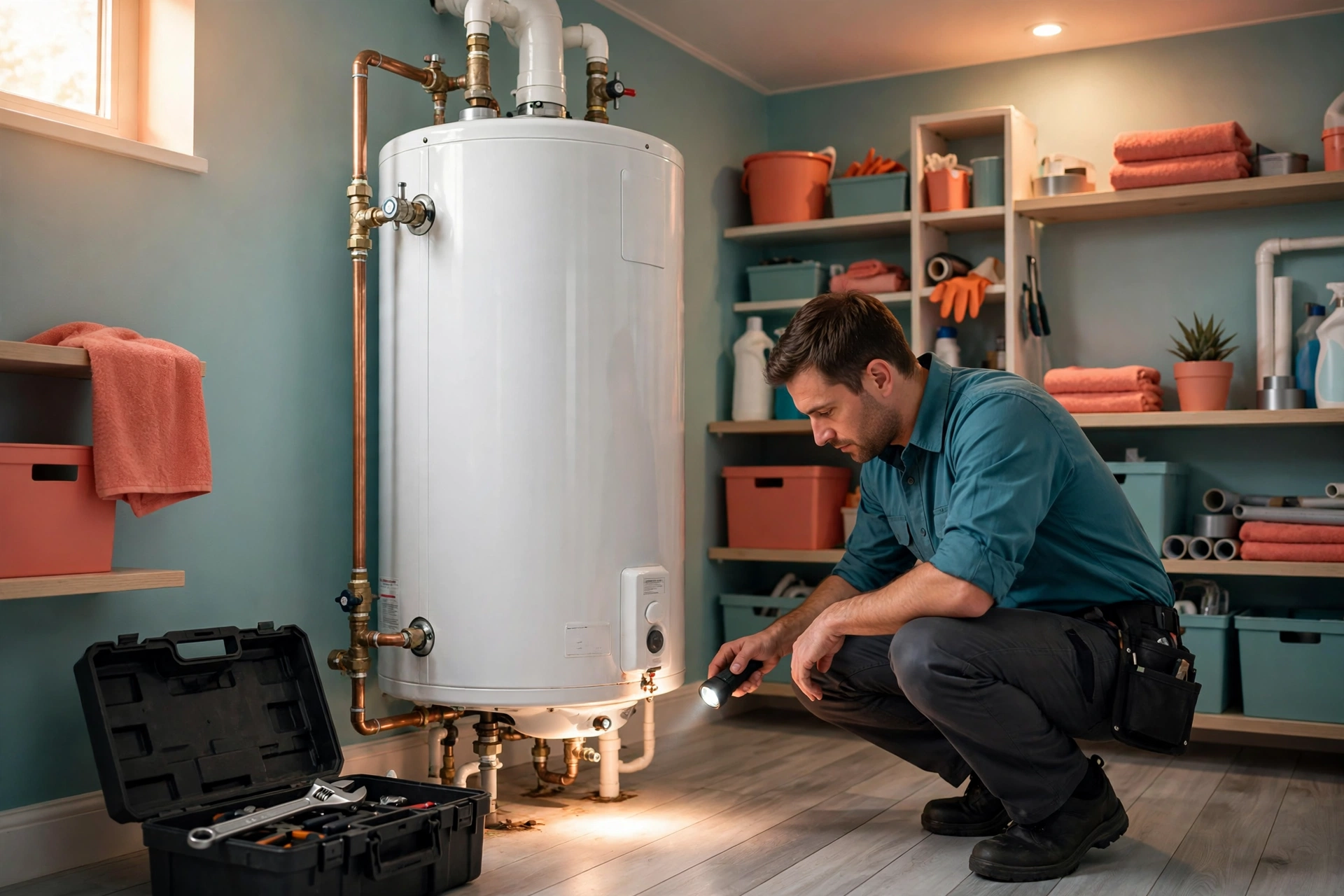
'Do tankless water heaters leak?' Yes — just differently. Understanding how each type fails is essential whether you're troubleshooting a current leak or choosing your next heater. Here's the honest comparison, without the sales pitch either direction.
Tanks fail at their weakest structural point: the steel vessel itself. Internal corrosion eventually breaches a seam or the tank wall, and when it goes, it goes big — up to 50 gallons on your floor. Before that catastrophe, tanks telegraph their decline through weeping fittings, dripping valves, and rust-colored water. The failure mode is well-understood and the maintenance playbook (flush, anode, pressure control) is proven over decades.
Tankless heaters have no reservoir to rupture, which eliminates the catastrophic-flood scenario. Instead they leak at connection points: the heat exchanger (from scale-induced stress or freeze damage), inlet/outlet fittings, isolation valves, and the condensate drain system. Leaks tend to be smaller in volume but can be more technically complex — and a leaking heat exchanger often means replacing expensive components.
For volume of potential water damage, tanks are riskier — there's simply more water inside. For frequency of service needs, tankless units demand more attention: annual descaling is mandatory, not optional, and skipped maintenance causes leaks sooner in tankless than in tanks. A maintained tank and a maintained tankless are both reliable; a neglected tankless fails faster than a neglected tank.
Tank repairs are generally cheaper — valves, elements, and anodes are inexpensive parts with straightforward labor. Tankless repairs skew higher: heat exchanger work and electronic components cost more, and diagnosis requires brand-specific knowledge. This is worth factoring into the total cost of ownership, not just the purchase price.
Choose tankless for endless hot water, space savings, and long service life — if you'll commit to annual descaling. Choose a tank for lower upfront cost, simpler maintenance, and cheaper repairs. Either way, enroll in maintenance from day one: call (833) 713-2101 and we'll set up the schedule that protects your investment.
Not like a tank can — there's no stored volume to release. But a failed fitting can still run indefinitely if undetected, so leak sensors remain wise.
Tankless: 18–20+ years maintained. Tank: 12–15 maintained. Maintenance is the deciding variable for both.
For the right household — high hot-water demand, space constraints, long-term ownership — yes. We evaluate gas capacity and venting before quoting any conversion.
Choosing between tank and tankless? Get honest, no-pressure guidance and a free replacement estimate from our team.
Call Now