How Long Do Water Heaters Last in Illinois?
Published 2026-10-10
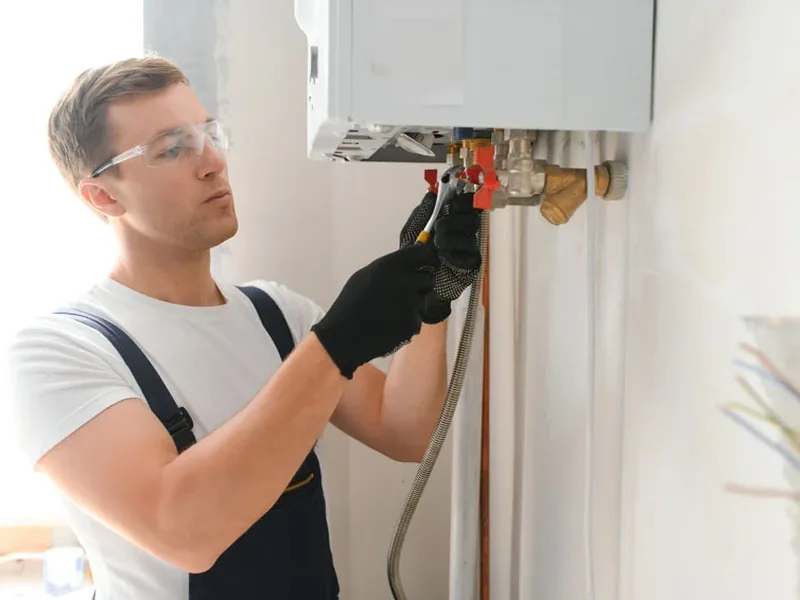
"How long should my water heater last?" is one of the first questions Wheaton homeowners ask when a leak appears — because the answer decides whether repair makes sense or replacement is smarter. The honest answer: it depends on the type, the water, and the maintenance. Here's what Illinois conditions do to each kind.
Typical Lifespans by Type
- Conventional tank (gas or electric): roughly 8–12 years. This is the workhorse in most Wheaton basements, and the range most homeowners should plan around.
- Tankless (on-demand): often 15–20 years with regular descaling. Without it, hard water can cut that dramatically — scale destroys heat exchangers.
- Heat pump / hybrid electric: roughly 10–15 years, though they're still uncommon in older DuPage County homes.
These are planning figures, not promises. We've seen neglected tanks fail at year seven and maintained ones run past fifteen. What moves a heater toward the long or short end is almost entirely water chemistry and maintenance.
Why Illinois Conditions Are Tough on Tanks
Wheaton's water comes from Lake Michigan via the DuPage Water Commission — good quality, but moderately hard. Hardness minerals settle as sediment on the tank bottom, where the burner or lower element superheats them. That sediment blanket does three kinds of damage: it insulates the water from the heat source (wasting energy), it creates hot spots that stress the steel, and it provides the gritty environment where corrosion accelerates. A tank that's never flushed in Wheaton ages faster than the same tank in a soft-water region — it's simply chemistry.
Then there's winter. Cold inlet water — sometimes in the 40s — forces longer, harder heating cycles from December through March. More cycles mean more thermal expansion stress on the tank and fittings, and more condensation on the cold inlet that keeps fittings damp. Add the simple fact that households use more hot water in winter, and Illinois heaters earn every year they survive.
The Maintenance That Actually Extends Life
Three tasks separate the 8-year tanks from the 14-year tanks:
- Flush sediment annually. Draining a few gallons (or a full flush) removes the mineral blanket before it bakes into concrete-like scale. In hard-water areas this is the highest-value maintenance there is.
- Replace the anode rod on schedule. The rod sacrifices itself to corrosion so the tank doesn't have to. In Wheaton's water it may last only 3–5 years. A fresh rod literally adds years to the tank — see our anode rod replacement guide for the details.
- Test the TPR valve yearly and keep the area around the heater dry and ventilated. A working relief valve and a dry environment prevent the two failure modes — overpressure events and external rust — that kill otherwise healthy tanks.
Our annual maintenance checklist lays out the full routine. (Note: that checklist link goes to our blog article of the same name at /blog/water-heater-maintenance-checklist/.)
Reading Your Heater's Age
Find the rating plate on the tank — every manufacturer encodes the build date in the serial number (each brand does it differently, but it's always there). If your tank is past year ten and has never been serviced, treat every symptom seriously: rust-colored water, rumbling, a weeping valve, or a damp base are end-of-life signals, not quirks. At that age, money spent on repeated part replacements is usually better directed toward a planned water heater replacement in Wheaton on your schedule — not at 2 a.m. during a cold snap.
The 50% Guideline for Repair vs. Replace
A practical rule: if the repair approaches half the cost of replacement and the tank is past roughly three-quarters of its expected life, replacement is usually the smarter money. A $400 gas valve on a 4-year-old tank? Repair it. The same valve on a 12-year-old tank with rusty water? You're buying months. Our technicians apply exactly this logic on every diagnosis — no upsell, just the math. For the full framework, read Repair or Replace? How to Decide.
Extending What You Have Right Now
If your heater is mid-life and healthy, the best time to start maintenance was at installation; the second-best time is today. A flush, an anode rod check, and a TPR test this year can realistically add productive years to the tank. And if you're already seeing warning signs, don't guess about the timeline — call Water Heater Leak Repair Rescue at (833) 713-2101. We'll assess the tank's real condition and give you a straight answer about how much life it has left.
Buying for Longevity: What to Look For
When replacement time comes, a few choices stretch the next heater's life in Illinois conditions. Look for a longer warranty tier — manufacturers typically put thicker anode rods and better linings in their extended-warranty models. Consider a powered anode rod from day one if your household goes through standard rods quickly. Size the tank correctly: an undersized heater cycles constantly and wears faster, while a correctly sized one runs calmer heating cycles. And whatever you buy, start the maintenance clock at installation — first flush at year one, first rod check at year two or three. A heater maintained from day one in Wheaton can realistically outlast its warranty by years; one ignored from day one rarely reaches it. Our replacement service sizes every unit to the household and sets you up with a maintenance schedule from the start.
On Wheaton's Lake Michigan water, a conventional tank heater lives about 8 to 12 years with minimal attention — right in line with national averages, since our moderately hard supply is neither gentle nor brutal. The spread within that range is almost entirely maintenance: a heater that's never flushed and never had its anode checked tends to exit near year 8 or 9, while one that gets annual flushes and an anode replacement mid-life routinely reaches 12 to 14. Tankless units run longer, 15 to 20 years, but only with the annual descaling our water demands; a neglected tankless heat exchanger can fail well short of that.
Wheaton's housing stock puts this in practical terms. The colonials, ranches, and split-levels built from the 1960s through the 1980s — the bulk of neighborhoods from Briarwood to the Danada area — are mostly on their second or third heater by now, and a surprising number of homeowners don't know which. The manufacture date is stamped on the rating plate (usually encoded in the serial number), and it's worth decoding: a heater you assumed was "about five years old" is sometimes eleven, which changes every repair-versus-replace calculation you'll make this year.
Stretching Lifespan in DuPage County
The lifespan playbook for our water is short: flush the tank every fall, check the anode rod every two to three years (every two if you have a softener), keep the thermostat at 120 degrees, and make sure the expansion tank is charged and functional so pressure spikes aren't hammering the tank shell. None of these is expensive or time-consuming; together they're the difference between replacing at year 9 and replacing at year 13. The 120-degree setting deserves emphasis — every 20 degrees hotter roughly doubles the rate of scale formation and corrosion chemistry inside the tank.
Use the warranty as a planning horizon, not a promise: a 6-year-warranty heater is built to a 6-year price point, and nursing one to year 10 is a win, not an expectation. The strategic move is planning replacement at 10 to 12 years — on your schedule, with time to choose the right size and handle any code upgrades — rather than at 13 during a January failure. In a Wheaton home with a finished basement, proactive replacement of an aging heater isn't just about hot water; it's the cheapest flood insurance you can buy.