TPR Valve Replacement in Wheaton, IL
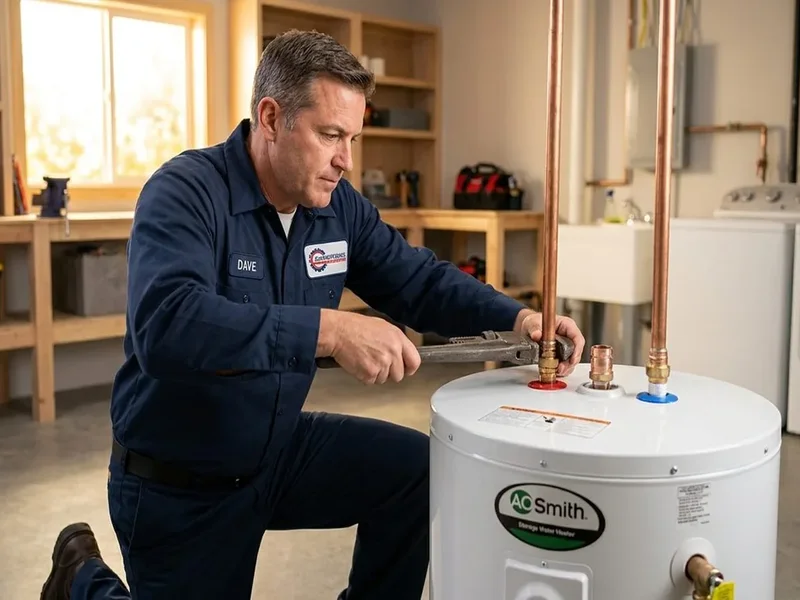
What the TPR Valve Does
The temperature and pressure relief (TPR) valve is the single most important safety device on your water heater. It sits on the top or upper side of the tank with a discharge pipe running down toward the floor. Its job is simple and critical: if the water temperature climbs too high or the pressure exceeds safe limits, the valve opens and vents hot water until conditions normalize. Without a working TPR valve, a malfunctioning thermostat or gas control can turn a water heater into a pressure vessel with catastrophic results.
TPR valves fail in two directions. A valve with a failed seat weeps or streams constantly — annoying, wasteful, and a sign something is wrong. A valve that is corroded shut or has been "tested" into failure will not open when it must — silent and dangerous. Both conditions call for replacement, and neither is a part to buy time on.
Signs Your TPR Valve Needs Replacement
- Water dripping or streaming from the discharge pipe with no recent heating cycle to explain it
- A discharge pipe that is warm when the heater has been idle for hours
- Mineral crust or green/white deposits around the valve body — evidence of long-term seepage
- The valve lever will not lift, lifts with grinding resistance, or will not reseat after testing
- A valve that is visibly corroded, with rust on the body or threads
- Water on the floor beneath the discharge pipe termination
- A valve of unknown age on a heater past 10 years old
- Any plumber's note from a past visit flagging the valve
One important distinction: a TPR valve that discharges only during or right after a heating cycle may be doing its job correctly against excessive pressure — the root cause could be thermal expansion or high household water pressure rather than a bad valve. We diagnose before we replace so you do not pay for a part that was not the problem.
Common Causes of TPR Valve Failure
Mineral deposits are the usual culprit. The valve seat and spring live in hot water constantly, and scale builds up on the seat until it cannot seal — hence the endless drip. Corrosion attacks the spring and body over years of service. Valves also fail from being exercised improperly: yanking the test lever on an old valve can dislodge scale that then prevents reseating, turning a test into a replacement. Excessive system pressure and thermal expansion make valves work overtime, wearing them out faster. And sometimes the valve was simply the wrong rating for the tank — replacements must match the tank's BTU input and working pressure, not just the thread size.
Our TPR Valve Replacement Process, Step by Step
1. Diagnosis first
We check household water pressure at a hose bib and ask when the discharge happens. If the valve only relieves during heating cycles and pressure reads high, we test for thermal expansion and a closed system before condemning the valve — an expansion tank may be the real fix, with the valve replaced as good practice anyway.
2. Safe isolation
We shut off the cold-water inlet and the energy source (gas to pilot/off, electric breaker off). For a top-mounted valve we can often work without draining the tank; for side-mounted valves we drain the tank below the valve level to avoid a scalding spill.
3. Removal and inspection
The old valve is unscrewed and the tank tapping inspected for corrosion or damaged threads. If the tapping is compromised, we address it before installing the new valve — a new valve in a damaged tapping will leak from day one.
4. Correct-rated replacement
We install a new TPR valve rated for the tank's BTU input and pressure, with fresh Teflon tape and pipe dope on the threads. "Close enough" ratings are not acceptable on a safety device.
5. Discharge pipe verification
We inspect the full discharge line: it must run downward, terminate within inches of the floor or to an approved drain, be full-size (never reduced), have no valve or cap anywhere in it, and not be threaded at the end. Deficient discharge piping gets corrected — a perfect valve on a plugged pipe protects nothing.
6. Refill, test, and check
We refill, purge air, restore energy, lift the test lever briefly to confirm the valve opens and reseats cleanly, and verify no seepage at the new joint through a heat cycle.
Equipment and Materials
TPR replacement is a compact job but needs the right parts: TPR valves in the common residential ratings (matched to tank BTU and pressure), brass fittings, Teflon tape and pipe dope, pipe wrenches, a pressure gauge for the hose-bib test, hoses for partial drain-down, and discharge-pipe material (typically CPVC or copper) for correcting deficient runs. We also carry expansion tanks and pressure-reducing valves for the cases where the valve was a symptom rather than the disease.
Safety and Precautions
This is safety-device work, so the precautions are non-negotiable. We never install a plug in place of a valve, never cap or valve the discharge line, and never reduce the discharge pipe size. We drain below the valve level before removing a side-mounted valve to prevent scalding. Homeowners should know: testing the TPR lever annually is recommended, but on a valve more than a few years old, be prepared for it not to reseat — keep our number handy at (833) 713-2101 before you lift that lever, or let us test it during a service visit. Never attempt to adjust or disassemble a TPR valve; it is a sealed, replace-don't-repair device.
Local Factors: Wheaton and DuPage County
In Wheaton's older housing stock, we regularly find original TPR valves on 15-plus-year-old tanks — valves that have been sitting in hot water since the house was built, their springs weakened and seats scaled. These are the valves that fail to reseat after a homeowner's well-meaning annual test, producing a panicked call about a suddenly streaming pipe. If your valve is that old, skip the DIY test and have it replaced proactively during any other heater service.
Thermal expansion is a frequent underlying cause in DuPage County because many homes have pressure-reducing valves or check valves on the service line, creating closed systems. The symptom — a TPR valve that dribbles after every heating cycle — gets misdiagnosed as a bad valve, replaced, and then dribbles again. We check for this pattern on every TPR call and install an expansion tank when the system needs one. Illinois plumbing code governs TPR discharge piping, and the City of Wheaton enforces it on replacements and new installs: proper termination, no threads at the end, no traps or valves in the line. We bring every discharge run we touch up to that standard.