Tankless Water Heater Leak Repair in Wheaton, IL
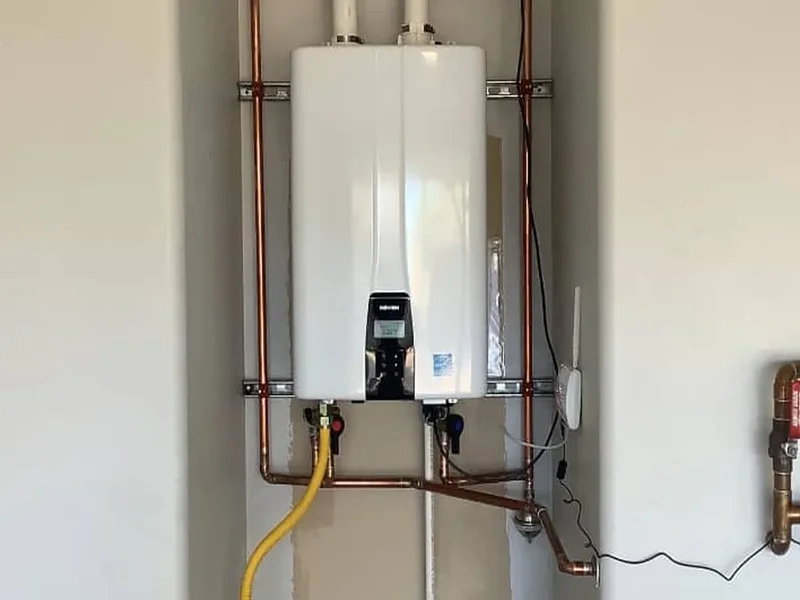
How Tankless Water Heaters Leak
Tankless (on-demand) water heaters do not store water, so they cannot rupture a tank — but they have plenty of other places to leak. The most common leak points are the water connections at the inlet and outlet, the internal heat exchanger, the condensate drain on high-efficiency condensing models, the pressure relief valve, and the isolation/service valves installed for flushing. Because a tankless unit only holds a small volume of water, its leaks usually start as slow seeps at a fitting rather than a flood — which makes them easy to ignore until the moisture damages the wall behind the unit or the electronics inside it.
Tankless leaks also behave differently from tank leaks: because the unit fires only when there is flow, a leak at the heat exchanger may appear only while hot water is running and vanish when the unit sits idle. If you see water under a tankless unit intermittently, note whether it coincides with hot-water use — that detail speeds diagnosis considerably.
Common Causes of Tankless Leaks
Scale buildup is the number one enemy of tankless units. Hard water deposits coat the inside of the heat exchanger, creating hot spots that stress the copper or stainless steel until it cracks or pinholes. Units that have never been descaled are the ones that develop exchanger leaks, and once an exchanger is cracked, the repair is usually a replacement of that component — the most expensive part of the unit.
Connection leaks come from worn gaskets at the water inlet/outlet unions, loose service valves, or corroded fittings. On condensing models, a clogged or improperly routed condensate drain backs acidic condensate up into the unit, corroding internal parts and leaking from the bottom. Freeze damage is a real risk: tankless units mounted on exterior walls or in garages can freeze in the heat exchanger during a power outage in winter, splitting the copper. Failed internal O-rings and gaskets, a weeping pressure relief valve, and improper venting that lets flue condensate run back into the unit round out the common causes.
Warning Signs
- Water dripping from the bottom of the unit, especially during or after hot-water use
- Error codes on the display (each manufacturer uses its own codes — note the number before calling)
- Fluctuating hot-water temperature or longer waits for hot water
- White or green crusty deposits around fittings — dried minerals marking a slow leak
- A musty smell or damp drywall behind or below a wall-mounted unit
- The condensate line dripping where it should not, or backing up
- Unusual rumbling or whistling during operation
- Higher gas bills with no change in usage (the unit working harder through scale)
Our Tankless Leak Repair Process, Step by Step
1. Powered-down inspection
We start with the unit off and cool, removing the cover to inspect the heat exchanger, internal piping, gaskets, and electronics for moisture trails, corrosion, and mineral deposits. We also check the wall and mounting area for hidden damage.
2. Pressurized leak isolation
With the cover off, we restore water pressure (not heat) and watch each joint and the exchanger while the unit is static, then run hot water and watch again under firing conditions. This separates fitting leaks from exchanger leaks.
3. Descale assessment
If scale is present, we measure its severity. A maintenance descale with a pump and food-grade descaling solution circulates through the service valves, dissolving deposits from the exchanger. This is both treatment and prevention — but it cannot repair a cracked exchanger, only reveal whether the metal underneath is sound.
4. Component repair or replacement
Gaskets, O-rings, service valves, inlet filters, pressure relief valves, and condensate components are replaced with manufacturer-correct parts. A cracked heat exchanger is replaced as a component when the part is available and the unit's age justifies it; on older units past their prime, we will tell you honestly when a new unit costs less than the repair.
5. Combustion and venting verification
After any internal repair, we verify gas pressure, combustion, and venting — especially the condensate routing on condensing models — then run the unit through hot-water demand and confirm zero leaks at every connection.
Equipment and Materials
Tankless service needs specialized gear: a descaling pump and hoses that connect to the unit's service valves, food-grade descaling solution, manufacturer-specific gaskets and O-ring kits, replacement service/isolation valves, pressure relief valves rated for the unit, condensate neutralizers and drain line components, manometer for gas-pressure checks, multimeter for sensor and igniter diagnostics, and leak-detection solution. We stock parts for the major residential brands commonly installed in the Chicago suburbs.
Safety and Precautions
Tankless units combine high-voltage electronics, gas combustion, and very hot water in a compact box — service is not a DIY project. We disconnect power before opening the unit, verify gas is off before touching the gas train, and never defeat the unit's safety sensors or error-code lockouts to "get it running." Condensing models produce acidic condensate that must drain through a neutralizer before hitting cast-iron drains — we check that routing on every visit. After any repair we confirm the pressure relief valve discharge is piped safely and that the vent termination outside is clear of obstructions, because a blocked vent on a gas tankless is a carbon-monoxide hazard.
Local Factors: Wheaton and DuPage County
Tankless adoption in Wheaton skews toward newer construction and recent remodels, and the units we service are often 5 to 12 years old — right in the window where a never-descaled heat exchanger starts to show scale damage. DuPage County's Lake Michigan-sourced municipal water is treated but still mineral-bearing, and without annual descaling the exchanger pays the price. If your installer did not add service valves, descaling requires cutting into the piping — we can add them during a repair visit so future maintenance is straightforward.
Winter freeze protection deserves special attention here. Wheaton's sub-zero stretches can freeze a tankless heat exchanger during a power outage, since the unit's built-in freeze protection needs electricity to run. Units on exterior walls or in garages are most exposed; if yours is in such a location, ask us about drain-down procedures for extended outages. Venting through an exterior wall also needs its termination kept clear of snow drifts — a buried vent intake shuts the unit down or, worse, recirculates exhaust. Finally, replacements and new installs in Wheaton require permits and must meet Illinois plumbing and fuel-gas code for venting clearances, gas sizing, and condensate disposal.