Emergency Water Heater Leak Repair in Wheaton, IL
What Counts as a Water Heater Emergency?
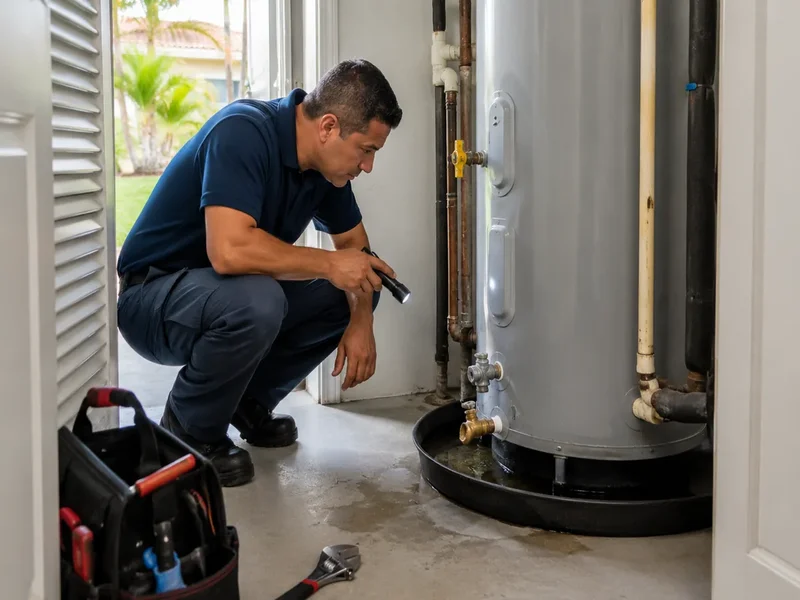
Not every drip is an emergency. A true water heater emergency in your Wheaton home is any leak you cannot control: water pooling across the floor faster than a towel can handle, a tank spraying from a fitting, the temperature and pressure (TPR) relief valve discharging a steady stream, the drain valve snapped off and gushing, or water visibly spreading toward walls, flooring, or finished spaces. A leaking tank that refills continuously can dump dozens of gallons into a basement or utility room in an hour, and where water reaches drywall, subfloor, or electrical, the damage compounds fast.
Other urgent signs include a sudden loss of all hot water accompanied by leaking, a strong smell of gas near a gas-fired unit, scorch marks or melted insulation around the burner area, a tank that is audibly rumbling or banging while leaking (heavy sediment with a cracked inner lining is a common combination in older tanks), or a water heater that trips its breaker repeatedly while sitting in standing water. Any of these means you should stop the water, kill the energy source, and get professional help the same day — not next week.
Common Causes of Emergency Water Heater Leaks
Tank failure is the number one cause of emergency calls. Glass-lined steel tanks corrode from the inside out once the sacrificial anode rod is spent and sediment buildup accelerates rust at the tank floor. When the steel gives way, leaks start as seepage and can rupture quickly under pressure — especially in tanks past the 10–12 year mark, which make up the majority of emergency leaks we see.
Failed inlet or outlet connections run a close second. Galvanic corrosion at dielectric unions, loose supply lines, or corroded nipples let go without warning. TPR valve failure is another: a relief valve that sticks shut lets pressure climb until something else fails, while a valve with a failed seat discharges endlessly and can scald anyone nearby. Cracked drain valves, split solder joints on older copper installs, and supply-line failures in freezing weather round out the usual suspects. Wheaton winter cold snaps are a real factor — units installed in unheated garages, crawlspaces, or additions with poor insulation can freeze at exposed piping, and the burst comes when the ice thaws.
What to Do Right Now: Immediate Steps
While you are waiting for help, take these steps — in this order — to limit damage:
- Shut off the water. Turn the cold-water inlet valve on top of the heater a quarter turn (or fully closed for a gate valve). If you cannot find it or it will not budge, shut the home's main water valve instead.
- Kill the energy source. For gas units, turn the gas control knob to OFF or PILOT. For electric units, switch the water heater breaker to OFF at your panel. Never touch electrical components while standing in water — call for help and stay clear if the breaker is not reachable dry.
- Relieve pressure carefully. If the tank is still hot, do not open the TPR valve lever to "drain" it — a rush of scalding water is more dangerous than the leak. Let it cool or let the technician handle it.
- Protect the area. Move valuables, rugs, and boxes away from the water. If water is approaching electrical outlets, the furnace, or the breaker panel, keep your distance.
- Call (833) 713-2101. Tell us the heater type (gas or electric), approximate age, and where the water is coming from. That lets us arrive with the right parts.
Our Emergency Repair Process, Step by Step
1. Rapid triage and water stop
On arrival we first confirm the leak source and make sure the water and energy are fully isolated. If a fitting or valve has failed and the tank itself is sound, we can often stop the leak within minutes by replacing the failed component.
2. Tank assessment
We inspect the tank shell, base, and seams. A tank that is leaking from the body itself — the bottom, a side seam, or the jacket weep holes — cannot be patched reliably and will need replacement. We give you a straight answer: repairable or not.
3. Safe drain-down
If the tank must come out, we drain it to a floor drain, sump pit, or outside using a hose, after verifying the TPR valve opens to admit air. A full 40- or 50-gallon tank weighs hundreds of pounds; we never drag a full tank across finished floors.
4. Repair or same-visit replacement
For repairable failures — inlet/outlet nipples, supply lines, TPR valve, drain valve, gas control, thermostat — we replace the failed part, refill, purge air, relight or re-energize, and test. If the tank has failed, we can typically install a replacement unit the same visit, reconnecting water, gas or electric, venting, and the TPR discharge line to code.
5. Verification and cleanup
We run the heater through a full heat cycle, check every joint for seepage with dry hands and a light, confirm the TPR valve and drain line are correct, and clean up water and debris from our work area.
Equipment and Materials We Bring
Emergency calls get a stocked service vehicle: pipe wrenches, tubing cutters, torch and solder or press fittings, dielectric unions, brass and stainless supply lines, TPR valves, drain valves, anode rods, thermostats and heating elements for common electric models, gas control valves, Teflon tape and pipe dope, hoses for draining, wet vacuums and absorbent materials for water control, and replacement tanks in the most common residential sizes. Arriving stocked is what turns an emergency into a same-visit fix instead of a return trip.
Safety Precautions That Matter
Water heaters combine three hazards — pressurized hot water, natural gas or 240-volt electricity, and combustion venting — so safety is not a footnote. We never energize an electric element before the tank is completely full (dry-firing destroys an element in seconds). Gas work means leak-testing every connection with solution after relight and verifying draft at the vent hood before leaving. On every job we confirm the TPR discharge line terminates safely — within inches of the floor or to an approved drain, never capped, never threaded at the end — because a plugged relief path is how tanks become pressure vessels. Homeowners should never attempt to repair a leaking tank body with sealants or clamps; these mask the failure while pressure continues to act on compromised steel.
Local Factors in Wheaton and DuPage County
Wheaton homes present a familiar pattern: many were built from the 1950s through the 1980s with basements that house the water heater near the furnace and laundry. Basement installations are forgiving for leaks until the water finds finished walls or stored belongings — and many Wheaton basements are finished living space now, which raises the stakes of a slow seep you do not notice for a day or two.
Municipal water in Wheaton comes from Lake Michigan through the DuPage Water Commission, and while it is treated, it still carries minerals that form sediment in tank bottoms over the years. Sediment is a quiet killer: it insulates the tank floor from the burner flame on gas units, overheats the steel, and accelerates the corrosion that ends in a rupture. Tanks that have never been flushed are the ones that fail hardest, and we see plenty of original-to-the-house units well past their expected life still in service across DuPage County.
Winter is the other local factor. Sub-zero stretches hit exposed piping in garages, mudrooms, and crawlspaces; even when the tank itself survives, a frozen and burst supply line at the top of the heater reads exactly like a heater failure. If your unit sits anywhere that is not consistently heated, pipe insulation and keeping the space above freezing are cheap insurance. Finally, the City of Wheaton requires permits for water heater replacements — emergency replacements included — so part of our process is making sure the installed unit, venting, and TPR discharge meet current code and are documented properly.