Thermostat Replacement in Wheaton, IL
What the Thermostat Does
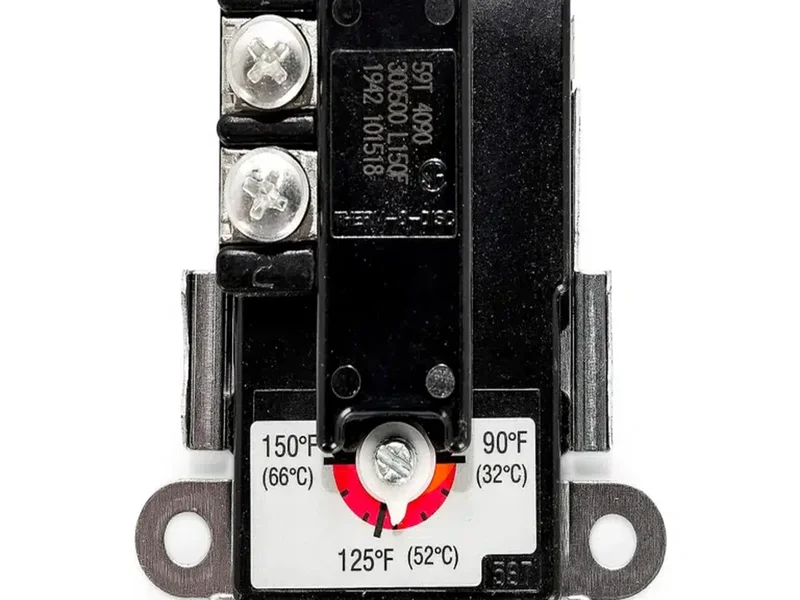
On gas water heaters, a single thermostat (part of the gas control valve assembly) senses tank temperature and tells the burner when to fire. On electric heaters, two thermostats — upper and lower — work with two heating elements in sequence: the upper thermostat heats the top of the tank first, then hands off to the lower. When a thermostat fails, the symptoms range from no hot water to dangerously overheated water, and the fix is replacement of the failed control.
Thermostats fail in both directions. A thermostat stuck open never calls for heat — you get lukewarm or cold water. A thermostat stuck closed never stops calling for heat — water overheats, the TPR valve starts discharging, and in extreme cases the tank is at risk. The second failure mode is the dangerous one, which is why overheating symptoms should never wait.
Signs Your Thermostat Needs Replacement
- No hot water at all, with the breaker on and the tank full (electric)
- Water that is scalding hot regardless of the thermostat setting
- The TPR valve discharging because the water is overheating
- Hot water that runs out much faster than it used to (one element/thermostat not working)
- A pilot that stays lit but the burner never fires (gas)
- Water temperature that swings wildly between hot and cold
- A thermostat dial that turns with no resistance or will not hold its setting
- Visible burn marks, melted plastic, or corrosion on the thermostat body (electric)
Common Causes of Thermostat Failure
Thermostats are electromechanical devices with a finite life — contacts pit and weld, bimetallic sensors drift out of calibration, and springs weaken. On electric heaters, sediment buildup is a major contributor: a thick sediment layer insulates the lower thermostat from the water, so it misreads temperature and cycles incorrectly, overheating or underheating. Moisture intrusion from a nearby leak corrodes terminals. Power surges and loose wiring overheat connections. On gas units, the thermostat is integrated with the gas control valve, so failure of the sensing element means replacing the whole gas control assembly. Age is the simplest cause — thermostats on a 10-plus-year-old heater owe you nothing.
Our Thermostat Replacement Process, Step by Step
1. Diagnosis
We verify the failure is the thermostat and not the element, gas valve, or wiring. On electric units we test both thermostats and both elements with a multimeter — replacing a thermostat when the element is the problem (or vice versa) is the classic misdiagnosis, and we check both before quoting. We also check for the sediment and moisture conditions that kill thermostats.
2. Power and energy isolation
Electric: breaker off, verified dead with a meter at the unit — 240 volts demands respect. Gas: gas control to off/pilot and the thermocouple circuit verified.
3. Access
Electric thermostats sit behind access panels under insulation on the tank side; we remove the panels and insulation carefully, noting wire positions. Gas thermostats are part of the gas control valve at the tank bottom — replacement means replacing the gas control assembly, which involves breaking and remaking the gas connection.
4. Replacement
Electric: the failed thermostat is disconnected wire-by-wire and replaced with a matching control, set to the same safe temperature as its partner (around 120°F). Gas: the gas control valve assembly is replaced, with new pipe dope on gas threads and the thermocouple and pilot tubing reconnected.
5. Testing and calibration
We restore power or relight, run the heater through full heating cycles, and verify with a thermometer at a tap that the water reaches — and does not exceed — the set temperature. Every gas joint is leak-tested with solution. We confirm the TPR valve is functional as the backstop.
Equipment and Materials
We carry upper and lower thermostats for common electric heater designs, gas control valve assemblies for the major residential gas models, multimeters and non-contact voltage testers, thermometers for outlet-temperature verification, pipe dope rated for gas, leak-detection solution, and replacement access-panel insulation. Because thermostat and element failures often travel together, we stock heating elements too — one visit, one diagnosis, both possibilities covered.
Safety and Precautions
Electric water heaters run on 240 volts, and the thermostat terminals are exposed once the access panel is off — we verify power is dead with a meter, not just by the breaker position, because mislabeled panels are common. We never bypass a thermostat or wire an element direct "to get hot water tonight"; an uncontrolled element will overheat the tank until the TPR valve — or the tank — gives way. On gas units, every disturbed gas joint is leak-tested before we leave, and we verify the burner shuts off at the set temperature rather than running away. Scalding protection matters too: we set thermostats to around 120°F unless you specifically request otherwise, and we confirm the TPR valve works as the last line of defense.
Local Factors: Wheaton and DuPage County
Thermostat failures in Wheaton track closely with sediment. DuPage County's mineral-bearing municipal water builds sediment layers in tanks that are never flushed, and that sediment is what cooks lower thermostats on electric units — we see this pattern constantly in 8- to 12-year-old electric heaters across the area. If your electric heater is misbehaving and has never been flushed, expect us to recommend a flush with the thermostat replacement; otherwise the new thermostat inherits the same hostile environment.
Winter adds a diagnostic wrinkle: incoming water in January and February is dramatically colder than in July, so a marginal thermostat/element combination that limped through summer fails outright in winter. A disproportionate share of our no-hot-water calls arrive during the first sustained cold snap. Gas control valve replacements in Wheaton also run into the area's older venting and combustion-air setups in mid-century basements — we verify draft and combustion air meet current Illinois fuel-gas code whenever we disturb a gas control, since the replacement must be safe in the installation as it exists, not as it was built. Permit requirements from the City of Wheaton apply to gas control replacements as they do to full heater replacements.