Tank Water Heater Leak Repair in Wheaton, IL
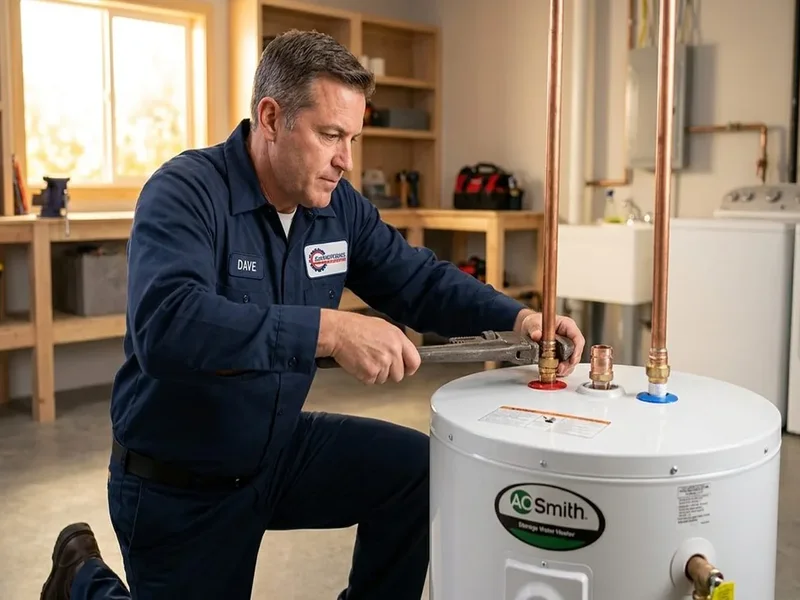
How Tank Water Heaters Leak
A conventional tank water heater is a steel tank wrapped in insulation and a jacket, holding 30 to 75 gallons of water under household pressure. Leaks show up in predictable places, and where the water is coming from tells you almost everything about whether the unit can be saved. Water on top of the heater near the inlet/outlet connections or the TPR valve almost always means a repairable fitting or valve. Water seeping from the bottom, from the jacket weep holes, or rust-stained puddles under the tank mean the steel itself has failed — and that tank will need replacement.
The telltale pattern of a dying tank is moisture you cannot trace to a connection: damp insulation, rust streaks running down the jacket, or a slow pool that returns after you dry it. Tanks also leak from the heating element gaskets on electric models and from the drain valve — both fixable. Learning to read these signs saves you from replacing a good tank over a bad valve, or nursing a doomed tank until it floods the basement.
Common Causes of Tank Water Heater Leaks
Internal corrosion is the leading cause. The glass lining inside the tank has microscopic imperfections, and the sacrificial anode rod exists to corrode in place of the steel. Once the anode is consumed — typically within a few years in hard-water areas if never replaced — rust takes hold at the tank floor where sediment collects. The result is pinholes and eventually a split in the steel. Sediment buildup accelerates this: minerals bake onto the tank floor, the burner overheats the steel beneath, and the weakened spot lets go.
Connection failures are the next most common: galvanic corrosion where copper meets steel without a dielectric union, loose supply lines, and corroded inlet/outlet nipples. Failed TPR valves discharge from the side of the tank; cracked plastic drain valves crack at the threads; electric element gaskets harden and weep with age. Thermal expansion in a closed plumbing system — common where a check valve or pressure-reducing valve blocks the water from pushing back into the municipal main — stresses every joint in the tank and can push a tired TPR valve into constant dripping. Excessively high household water pressure, above roughly 80 psi, does the same damage faster.
Signs Your Tank Heater Needs Attention
- Rust-colored hot water or a metallic taste, especially on first draw in the morning
- Rumbling, popping, or banging during heating — hardened sediment boiling under the flame
- Moisture or rust streaks around the base of the tank
- The TPR discharge pipe dripping or the drain valve weeping
- Hot water that runs out faster than it used to
- A pilot that keeps going out (gas) or a breaker that keeps tripping (electric)
- Visible corrosion on the inlet/outlet nipples or supply lines
- A tank past 10 years old with no service history
Our Repair Process, Step by Step
1. Leak-source diagnosis
We dry the area and trace the leak to its origin with a bright light and dry tissue at each joint. The first job is a firm answer: fitting failure (repairable) or tank-body failure (replace). We show you what we find rather than asking you to take our word for it.
2. Isolation and drain-down (when needed)
For top-fitting repairs, we shut off water and energy and often work without draining the tank. For bottom repairs, drain-valve replacement, or element work, we drain to a floor drain or sump pit, confirming the TPR valve opens so the tank vents properly.
3. Component replacement
Failed nipples, supply lines, dielectric unions, drain valves, TPR valves, element gaskets, and anodes are replaced with like-or-better parts — brass where brass belongs, never mismatched metals that will corrode again. Threaded joints get fresh Teflon tape and pipe dope; compression and soldered joints are remade cleanly.
4. Refill, purge, and relight
We refill with the hot-water taps open to purge air, verify the tank is completely full before energizing any electric element, relight the pilot or restore power, and set the thermostat to a safe temperature (around 120°F is the standard recommendation to prevent scalding).
5. Pressure check and test cycle
We check household water pressure at a hose bib and look for thermal-expansion symptoms. If pressure is high or the system is closed, we discuss an expansion tank — a small add-on that absorbs pressure spikes and extends the life of the new work. Then we run a full heat cycle and recheck every joint.
Equipment and Materials
Tank repairs run on hand tools and quality parts: pipe wrenches and adjustable wrenches, tubing cutters, torch and solder or press-fit tooling, dielectric unions, brass nipples, flexible stainless supply connectors, TPR valves, brass drain valves, element gaskets, magnesium or aluminum anode rods, Teflon tape and pipe dope, multimeter for electric diagnostics, combustion analyzer for gas checks, hoses, and a wet vacuum. For replacements we stock common 40- and 50-gallon gas and electric tanks so most jobs finish in one visit.
Safety and Precautions
Three hazards demand respect on every tank job: scalding water, gas or 240-volt electricity, and flue gases. We let overheated tanks cool before draining to avoid flash-steam burns, never bypass a TPR valve even "temporarily," and leak-test every gas joint after relight. On electric units we verify the tank is full before restoring power — dry-firing an element destroys it in seconds. We also verify the TPR discharge line is not capped, reduced, or threaded at its end, and that the flue drafts properly before we leave a gas unit running. If your tank sits in a finished basement, we recommend a drain pan under any replacement — a pan with a plumbed drain turns a future leak into a non-event.
Local Factors: Wheaton and DuPage County
Wheaton's housing stock is heavily weighted toward mid-century homes, and many water heaters we service are original equipment long past their expected service life — 15- to 20-year-old tanks still heating water are common in DuPage County basements. Those tanks tend to fail at the floor, where years of sediment have been baking against the steel. If your heater is in that age range and has never been flushed, plan for replacement rather than repair when the first leak appears.
The municipal supply — Lake Michigan water delivered through the DuPage Water Commission — is treated but still leaves mineral sediment over time, so annual flushing genuinely extends tank life here. Winter matters too: Wheaton sees extended sub-zero stretches, and tanks in unheated garages or additions need their exposed piping insulated; a burst supply line at the top of an otherwise healthy tank is a wintertime classic. The City of Wheaton requires a permit for water heater replacement, and replacements must meet the Illinois plumbing code for venting, TPR discharge, and combustion air — we handle the installation to those requirements and make sure the paperwork is in order.