Do You Need an Expansion Tank in Wheaton IL?
Published 2026-10-10
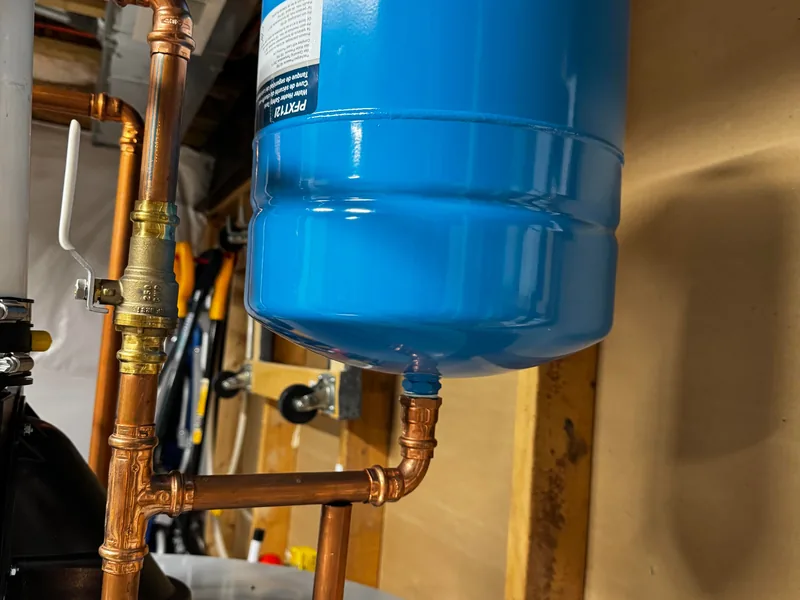
It's a small tank mounted above or beside your water heater, and most Wheaton homeowners have never noticed theirs — or never had one installed. The thermal expansion tank is one of those unglamorous parts that quietly prevents expensive problems. Here's what it does, why Illinois plumbing conditions make it important, and how to know if your home needs one.
What Thermal Expansion Is (and Why It Matters)
Water expands when heated — about 2–4% in volume across a normal heating cycle. In an "open" plumbing system, that extra volume simply pushes back into the municipal water main. But most modern DuPage County homes have closed systems: a check valve, pressure-reducing valve (PRV), or backflow preventer on the main line that stops water from flowing backward. With nowhere to go, each heating cycle spikes your home's water pressure — sometimes dramatically. That repeated pressure hammering stresses the water heater tank, flexes every joint and valve, and is a leading cause of premature TPR valve discharge, dripping fittings, and shortened tank life.
What the Expansion Tank Does
The expansion tank is a small steel tank divided by a rubber diaphragm: one side holds pressurized air, the other connects to your plumbing. When heated water expands, the extra volume pushes into the tank and compresses the air cushion instead of spiking system pressure. When the water cools, the air pushes it back. It's a shock absorber for your plumbing — simple, passive, and effective. A properly sized and pressurized expansion tank keeps system pressure stable through every heating cycle.
How to Tell If You Need One
- You have a PRV, check valve, or backflow preventer on your main line — that makes your system closed, and closed systems need expansion control. Many Wheaton homes got PRVs during meter upgrades or renovations.
- Your TPR valve drips or discharges after heating cycles, but the valve itself tests fine — classic expansion-pressure symptom. (See our TPR valve guide for the full diagnosis.)
- Pressure gauge readings climb significantly when the heater runs. A $15 gauge on the water heater drain valve or a laundry tap tells the story: if pressure jumps 20+ PSI during a heating cycle, expansion has nowhere to go.
- You're replacing a water heater. Most current installations in closed-system homes call for an expansion tank, and adding one during replacement is the cheapest time to do it.
- Fittings and supply lines keep weeping with no other explanation — chronic overpressure loosens everything slowly.
Signs Your Existing Expansion Tank Has Failed
Expansion tanks don't last forever — the diaphragm typically gives out in 5–10 years. A failed tank is worse than none because it hides the problem while providing no protection. Tap the tank: the top (air side) should ring hollow, the bottom (water side) thud solid. If the whole tank thuds — it's waterlogged, diaphragm ruptured. If water comes out of the air-valve stem on top when you press it, the diaphragm has failed. A waterlogged tank feels heavy and does nothing; replace it. We check expansion tanks as part of every leak detection visit, because failed expansion tanks are a frequent hidden cause of "mystery" TPR drips.
Sizing and Pressure Setting
Expansion tanks come in sizes matched to water heater capacity and supply pressure — a typical 40–50 gallon residential heater pairs with a 2-gallon expansion tank in most Wheaton homes, but high static pressure may call for larger. Critically, the tank's air precharge must match your home's static water pressure (measured with no water running). A tank precharged to 40 PSI on a 70 PSI system is nearly useless — the air cushion is already compressed before expansion even starts. Correct precharge is the difference between a tank that works and a decoration.
Installation Notes for Wheaton Homes
Expansion tanks mount on the cold-water inlet line, ideally supported — a water-filled 2-gallon tank is heavy, and hanging all that weight on a copper elbow is asking for a future leak. In tight Wheaton basements with low ceilings, wall-mount brackets keep the tank secure and serviceable. Installation involves shutting down the heater, cutting into the cold line, setting precharge pressure, and verifying with a gauge through a full heating cycle. It's routine work for a professional and usually completed in a single visit.
Not sure whether your system is open or closed, or whether your existing tank still works? Call Water Heater Leak Repair Rescue at (833) 713-2101. We'll check your system type, test pressure through a heating cycle, and give you a straight answer — including the honest "you don't need one" when that's the truth.
Expansion Tanks and Water Heater Warranties
Here's a detail that surprises homeowners: many water heater manufacturers' warranties assume the unit is installed with proper expansion control on closed systems. Chronic overpressure from uncontrolled expansion can be cited when warranty claims get reviewed — the tank failed from system conditions, not manufacturing defect. Whether or not fine print ever comes into play, the engineering logic is unavoidable: a tank absorbing pressure spikes it was never designed for will fail sooner. Installing the expansion tank at replacement time protects both the new heater and any warranty standing behind it. It's a small part that guards a big investment, and our Wheaton replacement service includes expansion assessment on every install.
Expansion tanks are unusually common in Wheaton because so many homes here have closed plumbing systems. Wheaton's municipal water pressure is healthy, and a large share of homes — especially those built from the 1980s onward in subdivisions around the Danada and Briarwood areas — have pressure-reducing valves (PRVs) or backflow preventers on the main line. Any device that stops water from pushing back into the city main creates a closed system, and in a closed system, heated water with nowhere to expand spikes the pressure. The Illinois Plumbing Code requires thermal expansion control in exactly this situation, which is why you'll find a small tank hanging above or beside most Wheaton water heaters.
The classic symptom of a failed expansion tank is a TPR valve that weeps or dribbles, particularly after long hot-water draws when the burner has been running hard. Homeowners often blame the TPR valve itself and replace it, only to watch the new one drip too — because the real problem is the waterlogged expansion tank no longer absorbing the pressure surge. Banging pipes when the heater fires, or a pressure gauge that reads fine at rest but climbs past 100 psi during recovery, points the same direction.
Checking the Air Charge on a Wheaton Heater
An expansion tank only works if its internal air bladder is charged to match your home's water pressure — typically 40 to 60 psi in Wheaton. Checking it takes a tire gauge on the Schrader valve at the tank's end: with the water pressure relieved, the reading should match your house pressure. If water hisses out of that air valve instead of air, the bladder has ruptured and the tank is done. Replacement tanks are sized to the heater — a 2-gallon tank suits most 40- and 50-gallon residential heaters — and they hang on the cold-water inlet where the old one sat.
Expect an expansion tank to last roughly 5 to 8 years, noticeably less than the heater it protects, so plan on replacing it at least once during a heater's life. The smartest time to do it is during the heater replacement itself, when the system is already drained and a technician is already on site — bundling the two avoids a second service call and guarantees the new heater starts life with proper expansion control from day one.