Water Heater Thermostat Replacement Guide
Published 2026-10-10
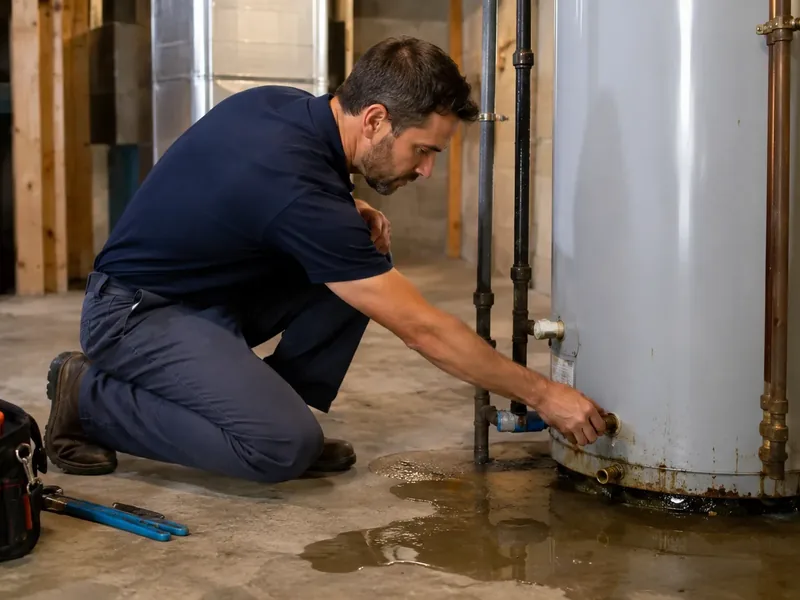
Water too hot, water never hot enough, water that swings between scalding and cold — when the temperature goes wrong on a water heater, the thermostat is a prime suspect. Thermostat replacement is one of the most straightforward and economical water heater repairs, but only when the thermostat is actually the problem. Here's how to tell, what replacement involves for gas and electric units, and when temperature trouble means something bigger.
What the Thermostat Does
On electric heaters, two thermostats (upper and lower) sequence the two heating elements: the upper brings the top of the tank to temperature, then hands off to the lower. Each has a high-limit reset button — a safety that trips if the water overheats. On gas heaters, the thermostat is integrated into the gas control valve, sensing temperature through a probe immersed in the tank and modulating the burner accordingly. Different hardware, same job: keep the water at your setpoint.
Signs Your Thermostat Is Failing
- Water far hotter than the dial setting — the thermostat isn't cutting off the heat source. (Verify the dial wasn't bumped first.)
- Water never reaches the set temperature — the thermostat satisfies early or never calls for heat properly.
- Temperature swings between hot and cold during a single use — erratic thermostat behavior, especially on electric units where upper/lower handoff misfires.
- High-limit reset keeps tripping (electric) — the little red button behind the upper access panel pops repeatedly. It trips for a reason: overheating. Resetting it without finding the cause is masking a problem.
- No hot water with good elements/burner — the heat source is fine but never gets the signal. (Diagnosis must rule out elements first on electric units.)
Thermostat vs. Element vs. Sediment: The Right Diagnosis
These three produce overlapping symptoms, and misdiagnosis wastes money:
- Sediment-heavy tank: runs out fast, rumbling noises, slow recovery — the tank is full of scale, not broken. Flush first.
- Failed element (electric): runs out fast or never heats — test elements with a multimeter; no continuity means dead element. See our heating element guide.
- Failed thermostat: temperature wrong relative to setting, swings, tripped high-limit — test thermostat operation and calibration.
The professional sequence is: check settings, assess sediment, test elements, test thermostats — then replace what's actually failed. Our thermostat replacement service follows exactly this order, so you never pay for a thermostat when the tank just needed flushing.
What Replacement Involves: Electric Units
Electric thermostat replacement is quick professional work: power off at the breaker (verified), access panels removed, wiring documented and disconnected, old thermostat unclipped from the tank, new one seated flush against the tank wall (contact matters — it senses through the steel), wiring reconnected, temperature set to 120°F, panels closed, power restored, and operation verified through a heating cycle. Both thermostats are often replaced together on older units — they've shared the same life, and the incremental cost beats a second visit.
What Replacement Involves: Gas Units
On gas heaters the thermostat lives inside the gas control valve — there's no separate thermostat part to swap. "Thermostat replacement" on a gas unit means gas control valve replacement: gas shut off, line disconnected, valve unthreaded, exact-match valve installed, connections leak-tested, pilot relit, burner and temperature verified. It's a bigger job than the electric equivalent, which is why the repair-vs.-replace math deserves extra care on older gas tanks.
When Temperature Problems Mean a Bigger Decision
A thermostat on a healthy 5-year-old tank: replace it, obviously. But weigh carefully when:
- The tank is 10+ years old — thermostats rarely die alone at that age; the tank, rod, and valves are all end-of-life together.
- Overheating has been happening — chronic over-temperature accelerates tank corrosion and stresses the TPR valve. The underlying damage may exceed the thermostat.
- The high-limit trips repeatedly after resets — something is driving overheating; find it before it finds your TPR valve's limit.
Run these through our repair-or-replace framework — and if you're unsure, call Water Heater Leak Repair Rescue at (833) 713-2101. We'll test the full control chain, replace only what's failed, and tell you straight whether the tank deserves the investment.
Calibrating and Verifying After Replacement
Installing the part is half the job — verifying it is the other half. After any thermostat replacement, the technician should confirm the new thermostat's calibration against actual water temperature: run hot water at the nearest tap with a thermometer and compare to the dial setting. A quality replacement holds within a few degrees of setpoint through a full heating cycle and a full cool-down. On electric units, both upper and lower thermostats get verified through the handoff sequence — upper heats first, then lower — because a miswired or mis-seated thermostat can mimic the original failure. The high-limit safety gets a functional check too. If your "repaired" heater still runs hot or cold after a thermostat swap, the verification step was skipped — call us at (833) 713-2101 and we'll do the diagnosis properly, including the sediment and element checks that should have come first.
Thermostat Lifespan and Failure Causes
Thermostats are durable — they often last the life of the tank — which is why premature failure deserves a "why." Common killers: power surges and brownouts (electric units), chronic overheating from sediment (the thermostat works overtime against the scale blanket), moisture intrusion from a nearby leak dripping onto the controls, and simple contact wear after a decade of cycling. A thermostat that fails at year three on a sediment-packed tank isn't bad luck; it's a symptom. That's why our service always pairs thermostat replacement with a sediment assessment and a look at the tank's overall condition — fixing the part without addressing the cause just schedules a repeat visit.
Thermostat trouble wears different disguises on gas and electric heaters, and Wheaton has plenty of both. On a gas heater, the "thermostat" is part of the combination gas control valve — a single assembly that meters gas and regulates temperature together — so thermostat failure there means replacing the whole valve. On electric heaters, separate upper and lower thermostats clip against the tank under access panels, and they fail independently: a dead upper thermostat means no hot water at all, while a dead lower one gives that classic short burst of hot water followed by lukewarm disappointment.
The symptom that sends most Wheaton homeowners looking is temperature misbehavior — water scalding hot despite a moderate dial setting, or never getting hot no matter how high you set it. Before condemning the thermostat, rule out the impostors: heavy sediment insulates the tank bottom and overheats the lower area on any heater type, and on electrics, a failed heating element produces nearly identical symptoms to a failed thermostat. Testing, not guessing, is what separates a lasting fix from a parts-swapping exercise.
Replacing Thermostats the Right Way
On electric heaters, thermostat replacement starts at the breaker panel: kill the double-pole breaker and verify both legs are dead with a tester, because this is 240-volt work. Thermostats are inexpensive, so replace upper and lower as a pair — if one has failed after years on Wheaton's hard water, the other is living on borrowed time. Set both to 120 degrees, the temperature safety agencies recommend: it prevents scalding, slows scale formation, and still feels properly hot at the tap. Resist the winter temptation to crank it higher; hotter settings precipitate minerals faster and buy you nothing in recovery speed.
On gas heaters, remember that a thermostat problem is a gas valve replacement, which involves breaking gas connections and must match the unit's BTU rating and gas type exactly. After any gas valve work, verify proper vent draft and confirm the home's carbon monoxide alarms are functional — Illinois requires them, and gas appliance service is the natural moment to check. And apply the age test honestly: new thermostats on a 13-year-old tank are good money after bad. If the heater is past its tenth birthday and needs a gas valve or a full set of thermostats plus elements, price the replacement — you'll likely find the math favors starting fresh.