How Professionals Detect Water Heater Leaks
Published 2026-10-10
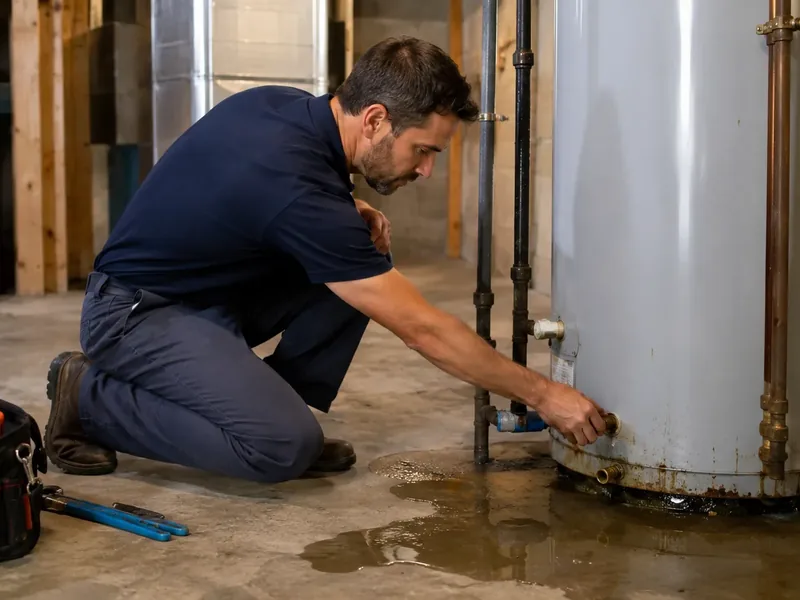
Water near your heater, but you can't tell where it's coming from. The base is damp, the pipes are dry-ish, and everything looks suspicious and nothing looks guilty. This is where professional leak detection earns its keep — because water travels, evaporates, and lies about its origins. Here's how technicians actually track a water heater leak to its source.
Why Leak Sources Are Hard to Find
Water is sneaky in basements. It wicks along copper pipes far from the leak point, runs down the tank jacket from a top fitting and appears at the base, evaporates off warm surfaces leaving only mineral ghosts, and hides behind insulation and stored boxes. Add Wheaton basement humidity — where condensation muddies every clue — and DIY diagnosis becomes guesswork. Professionals work from a method, not hunches.
Step 1: The Interview and Visual Survey
Detection starts with questions: when did you first notice it, is it constant or intermittent, gas or electric, how old is the unit, any recent work? Then a systematic visual pass with a bright flashlight: top fittings, TPR valve and discharge pipe, drain valve, anode port, the jacket seams, the base perimeter, and the floor slope around the heater (water pools at the low point, which may be feet from the source). Fresh rust streaks, white/green mineral crust, and water staining each point in different directions — an experienced eye reads them like a map.
Step 2: Isolation by Drying and Testing
The core technique is beautifully simple: dry everything, then watch what gets wet first. The technician dries the tank, pipes, and floor completely, then lays dry paper towels or leak-detection strips at each suspect point — under each fitting, along the TPR discharge, around the drain valve, at the base perimeter. Then the system is run through a heating cycle (pressure and temperature both peak then, which is when leaks show themselves). The first towel to dampen is the prime suspect. It's the professional version of the paper towel test, executed systematically at every candidate point simultaneously.
Step 3: Component-by-Component Verification
Once a suspect is identified, each candidate gets a specific test:
- Fittings: dried and watched under full pressure; weeping threads show within minutes.
- TPR valve: discharge pipe monitored through a heating cycle; pressure gauge readings distinguish valve failure from expansion pressure (see our TPR guide).
- Drain valve: paper towel on the spout; also checked for seepage around the threads.
- Tank shell: the critical distinction — moisture emerging from under the jacket or through seams with dry fittings above means shell failure. Sometimes confirmed by carefully inspecting with jacket panels shifted, or by the pattern of rust blooming through the jacket.
- Nearby plumbing: supply lines, shutoff valves, and even condensation from cold pipes get ruled out so the heater isn't blamed for a neighbor's leak.
Step 4: Pressure and System Testing
A pressure gauge on the drain valve or a hose bib reveals what eyes can't: static pressure, pressure spikes during heating (expansion problems), and whether the system is closed. Thermal imaging cameras can show hot-water migration inside walls and under the jacket — a hot streak where only cold should be is a leak's thermal fingerprint. Moisture meters quantify dampness in surrounding materials, distinguishing active leaks from old stains.
What Detection Costs Relative to Guessing
Here's the economics that matter: a proper diagnosis is a fraction of any repair, and it prevents the expensive mistake — replacing a water heater for a $30 fitting leak, or replacing fittings for a failed tank. We've seen both. Detection-first is also faster: the technician arrives with the right parts because the source is known. For how diagnosis fits into overall job economics, see what affects water heater leak repair costs.
When Detection Reveals the Tank Is Done
Sometimes the methodical answer is the one nobody wants: the shell itself is weeping, and no component replacement will fix it. A professional delivers that verdict with evidence — the dry-fittings/wet-shell pattern, the rust bloom locations, the tank's age and condition — not as an upsell but as a finding. At that point the honest path is our repair-or-replace framework, and a planned replacement beats an emergency one every time.
Mystery moisture around your heater? Stop guessing. Call Water Heater Leak Repair Rescue at (833) 713-2101 for professional water heater leak detection in Wheaton — we'll find the real source and show you the evidence before recommending anything.
DIY Detection: What Homeowners Can Do Before Calling
You can run a simplified version of the professional method yourself. Start by clearing everything away from the heater so you can see all sides — boxes hide leaks. Dry the tank, pipes, and floor thoroughly with towels. Then place dry paper towels at each suspect point: under every top fitting, along the TPR discharge pipe's end, at the drain valve spout, and in a ring around the base. Don't use hot water for 2–4 hours (or run a normal cycle and watch during it), then check each towel. The wet one's location is your answer in most cases. Photograph everything — the towel positions and the wet patterns — before you touch anything else. When you call (833) 713-2101, those photos let us arrive with the right parts and a head start. What DIY can't do reliably: distinguish shell weeps from jacket condensation, assess pressure/expansion causes, or safely open gas-unit cabinets — that's where the professional visit earns its keep.
Detection Tools in the Technician's Kit
Beyond towels and flashlights, professionals bring instruments that remove guesswork. Infrared thermometers and thermal cameras reveal hot-water migration — a warm streak on a cold pipe is a leak's signature. Pressure gauges with recording capability capture expansion spikes through full heating cycles. Moisture meters quantify dampness in drywall and framing near the heater, separating active leaks from historical stains. Combustion analyzers (gas units) verify the burner isn't contributing condensate misdiagnosed as a leak. None of these replace the systematic dry-and-watch method — they corroborate it. A finding supported by two independent methods (visual pattern + thermal image, say) is a finding you can spend money on with confidence.
The best leak detection in a Wheaton home starts with knowing where to look. Unfinished basements make it easy: bare concrete shows every drip as a dark spot, and rust trails or white mineral crust on the tank shell map exactly where water has been traveling. Check the TPR discharge pipe outlet, the drain valve, the top supply connections, and the tank base seam — in that order, since that's the order of likelihood. Finished basements are the hard case, because the leak hides behind drywall or under carpet; there your early warnings are a musty smell that wasn't there last month, baseboards pulling away from the wall, or a damp patch that never fully dries.
Technology fills the gap that eyes can't. A fifteen-dollar battery water alarm on the floor behind the heater screams loud enough to hear upstairs the moment water touches it — it's the highest-value purchase in home leak prevention. Step up from there and you get smart sensors that send phone alerts, and automatic shutoff valves that close the water main when a sensor gets wet. For a Wheaton homeowner with a finished basement and an aging heater, that combination is genuinely cheap insurance against a five-figure remediation.
When the Water Bill Tells the Story
Wheaton's municipal water billing can catch leaks your eyes miss. A TPR valve stuck open or a hot-water line leaking inside a wall can waste hundreds of gallons without a single visible puddle near the heater — but it shows up as a sudden jump on the quarterly bill. If your usage spikes with no change in household habits, check the heater area first, then the toilets (a running toilet is the classic silent waster), then look for warm spots on basement floors that suggest a slab leak. Comparing each bill against the same quarter last year turns the water bill into a leak detector you already own.
For hidden leaks behind finished walls, professionals bring moisture meters and thermal imaging cameras that see damp drywall and track water paths without demolition. A pressure test of the plumbing system can confirm whether water is escaping somewhere in the walls at all. Most Wheaton heater leaks never need that level of investigation — eyes, alarms, and the water bill catch the vast majority — but when the signs say "water" and the heater looks dry, it's worth knowing the tools exist before anyone starts opening walls at random.