Winter Frozen Pipes and Water Heater Leaks in Wheaton, IL
Published 2026-10-12
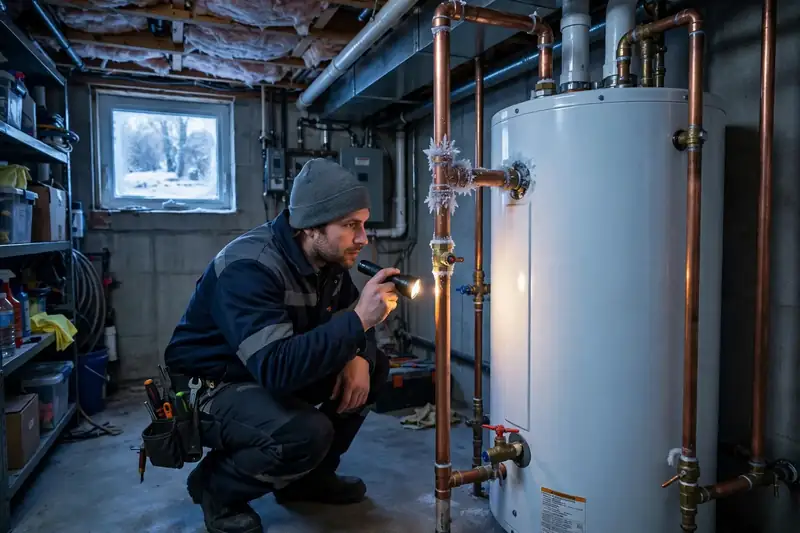
Every January, DuPage County reminds us that Chicago-area winters are not a mild inconvenience — they are a full-contact sport. When the polar vortex drops temperatures to twenty below zero, the plumbing in Wheaton homes takes a beating. And one of the most common casualties is hiding in your basement, utility room, or garage: your water heater. Frozen pipes near a water heater don't just stop the hot water — when they burst or thaw, they can crack fittings, split supply lines, and turn a small drip into a flooded basement. This guide covers why Wheaton winters are so hard on water heaters, where your home is most vulnerable, and exactly what to do before, during, and after a deep freeze.
Why DuPage County Winters Are So Hard on Water Heaters
Wheaton sits in the heart of DuPage County, where January lows routinely dip into the single digits and stretches of subzero weather arrive every winter. The ground freezes to a depth of roughly three to four feet, and wind chills can push effective temperatures far below what the thermometer shows. That matters for plumbing because cold air finds every unsealed gap — around rim joists, through crawl space vents, along exterior walls — and steel and copper pipes lose heat fast.
Water heaters are especially exposed because they connect to the coldest part of your plumbing: the incoming cold-water supply line. That line runs from your water meter or well entrance — often through an unconditioned corner of the basement or along a garage wall — straight into the top of the tank. If the supply line freezes, two things can happen, both bad. First, the expanding ice can split the pipe itself, usually at a joint or elbow, and you won't know until it thaws and water starts spraying. Second, a frozen section acts like a plug. If your water heater keeps firing with no way for expanded water to move, pressure builds inside the tank. That's when the temperature-and-pressure (T&P) relief valve earns its keep — or, if that valve is old or stuck, when tank seams and fittings get stressed beyond what they were designed to handle.
The result we see most often after a hard freeze in Wheaton: homeowners wake up to no hot water, a strange hissing or dripping sound near the heater, or — the worst version — come home from work to a basement floor covered in water where a frozen line thawed mid-afternoon and sprayed for hours.
Where Wheaton Homes Are Most Vulnerable
Wheaton's housing stock tells the story of a suburb that grew in waves, and each wave has its own freeze risks:
- 1950s–60s ranch and split-level homes (common across north and central Wheaton): many have water heaters in utility rooms or corners of unfinished basements, with supply lines routed along exterior foundation walls. Insulation standards were lower when these homes were built, and rim-joist areas are often under-insulated.
- Older homes near downtown Wheaton and the Wheaton College area: beautiful, but frequently plumbed with runs through crawl spaces or additions where pipes travel outside the original heated envelope. A pipe that was fine for decades can freeze the first time a bitter polar vortex arrives.
- Homes with water heaters in garages: some older Wheaton properties have heaters installed in or adjacent to unheated garages. Even with a garage door closed, temperatures in an attached garage can sit near freezing during a cold snap — and drop well below it if the door is left open or the opener fails.
- Vacation or unoccupied homes: Wheaton residents who travel for the holidays sometimes set the thermostat back aggressively to save on their Nicor Gas bill. If the furnace can't keep up during a subzero night, the house temperature can fall into the danger zone for pipes.
Beyond the house itself, two utility realities shape winter risk here. Nicor Gas serves most of Wheaton, and during extreme cold snaps the gas system is under its heaviest load of the year — a gas water heater that cycles constantly is working at maximum stress. ComEd outages, while not frequent, do happen during winter storms; a power outage that stops your furnace for even a few hours can let interior temperatures crash if the house isn't well sealed.
How a Frozen Pipe Turns Into a Water Heater Leak
The mechanics matter because they tell you where to look once things thaw. Ice expands with enormous force — enough to split copper and crack brass fittings. The damage usually shows up in one of these places:
- Cold-water supply line to the heater. The most common burst point. When it thaws, water sprays from the split directly above or beside the tank, and homeowners often mistake it for a tank leak.
- Hot-water outlet line. Less common but the same physics. A split here leaks hot water, which steams and can scald.
- T&P relief valve discharge pipe. If this pipe runs to the outside or through an unheated space, it can freeze shut. A blocked discharge line is a safety issue, not just a leak risk — the valve can't relieve pressure if its outlet is plugged with ice.
- Tankless unit condensate lines and venting. Tankless water heaters, increasingly popular in Wheaton remodels, produce acidic condensate that drains through a small line. If that line freezes, the unit shuts down or backs up. Exterior vent terminations can also ice over in extreme cold.
- Fittings and valves near the heater. Shutoff valves, dielectric unions, and soldered joints expand and contract with temperature swings. A joint that survived forty winters can give up during the forty-first if the freeze is deep enough.
There's also a sneakier failure mode: partial freezing. A pipe doesn't have to freeze solid to cause damage. Repeated freeze-thaw cycles flex joints back and forth, loosening connections over the course of a winter. By February, a fitting that was tight in November may be weeping — a slow drip that soaks the floor around the heater for weeks before anyone notices.
Warning Signs a Pipe Is Freezing Near Your Water Heater
Catch it early and you can often prevent the burst entirely. Watch for:
- Reduced water flow or pressure at hot-water taps — the first sign ice is narrowing a line.
- Strange sounds near the heater: whistling, banging (water hammer from restricted flow), or gurgling.
- Frost or condensation on exposed pipes in the basement or utility room.
- A water heater that runs constantly but delivers lukewarm water — restricted cold-water inlet can starve the tank.
- Unusual cold spots on walls near where pipes run.
If you notice these during a cold snap, don't wait to see whether it gets better on its own. It won't — temperatures keep falling overnight, and the freeze only gets worse.
Your Pre-Winter Prevention Checklist
The best time to winterize is October or November, before the first hard freeze. Here's what actually works in Wheaton homes:
- Insulate exposed pipes. Foam pipe sleeves on every exposed run in the basement, crawl space, garage, and along exterior walls. Pay special attention to the cold-water inlet to your water heater. This is the single highest-return winter prep you can do.
- Seal air leaks. Caulk and foam around where pipes penetrate exterior walls, and check rim-joist insulation in the basement. Cold air blowing directly on a pipe defeats insulation.
- Keep the heat on — no lower than 55°F — even when traveling. The savings from setting back further are trivial compared to the cost of a burst pipe. If you're gone for the holidays, have someone check the house.
- Open cabinet doors on sinks along exterior walls during extreme cold so warm air reaches the pipes.
- Let faucets drip on the coldest nights — a pencil-thin stream from the faucet farthest from the meter keeps water moving. Moving water freezes far less readily than standing water.
- Disconnect and drain outdoor hose bibs. A frozen hose bib can back ice into interior piping.
- Service the water heater before winter. A fall tune-up — checking the T&P valve, testing the shutoff valve, flushing sediment — means the unit enters the hardest season in its best condition. Our seasonal water heater care guide walks through the full checklist.
- Know where your main water shutoff is — and make sure the valve actually turns. Test it in the fall. In a burst-pipe emergency, shutting off water in the first minute versus the tenth minute is the difference between a mop-up and a major claim.
- Consider heat tape on problem runs that have frozen before, installed per manufacturer instructions with a thermostat control.
- For tankless owners: verify the condensate drain line is insulated or routed through conditioned space, and check that exterior vent terminations are clear of snow and ice.
What to Do If a Pipe Bursts Near Your Water Heater
Act in this order:
- Shut off the main water supply immediately. Don't hunt for the exact split first — stop the water.
- Shut down the water heater. For a gas heater, turn the gas control to pilot or off. For electric, switch off the breaker. A heater firing with no water in the tank can overheat and crack.
- Open faucets to drain remaining pressure and give thawing ice somewhere to go.
- Call for help. A burst pipe near a water heater is an emergency — call Water Heater Leak Repair Rescue at (833) 713-2101. We handle the pipe repair and the water heater assessment together.
- Start cleanup. Move valuables, get standing water up with a wet vacuum or towels, and run fans and a dehumidifier. Mold can start growing within 24–48 hours in a warm basement.
What NOT to do: don't use an open flame (propane torch) to thaw pipes — it's a fire hazard and can damage solder joints. Don't ignore a burst and hope the cold passes; ice in the line will keep expanding. And don't restart a gas water heater yourself if you smell gas — leave the house and call Nicor Gas.
After the Thaw: Inspect Before You Relax
Once temperatures recover and repairs are made, don't assume everything is fine. A freeze event stresses the whole system. Have the following checked:
- The T&P relief valve — test that it opens and seats properly. If its discharge line froze, it needs inspection.
- All fittings and joints near the heater for slow weeps that only show under pressure.
- The shutoff valve — freeze cycles can seize old gate valves.
- Water pressure — a pressure spike from the freeze may have damaged the expansion tank. See our expansion tank guide for what to check.
- The tank itself — if the heater ran dry or overheated during the event, hairline damage to the tank lining can show up months later as a leak.
A post-winter inspection in March is cheap insurance. Many of the water heater leaks we repair in Wheaton each spring trace back to damage from a January freeze that nobody noticed at the time. If you're unsure whether your system came through the winter clean, our leak detection service can verify it before a slow problem becomes an expensive one.
Winter in Wheaton is coming either way. The homeowners who get through it with dry basements are the ones who prepare in the fall, know their shutoff valve, and call early when something looks wrong. If your water heater needs a pre-winter checkup — or you're already dealing with freeze damage — call (833) 713-2101. We serve Wheaton and all of DuPage County around the clock.